

Why Sleep Matters: The Powerful Link Between Bedtime Routines, Development and Wellbeing
Sleep isn’t simply a period of rest. It’s an active biological process that underpins physical health, emotional regulation, cognitive functioning and overall wellbeing. Across childhood and adulthood, the quality of sleep, not just the quantity, plays a critical role in how individuals think, feel and function each day (Scott & Woods, 2020).
Sleep as a Foundation for Wellbeing
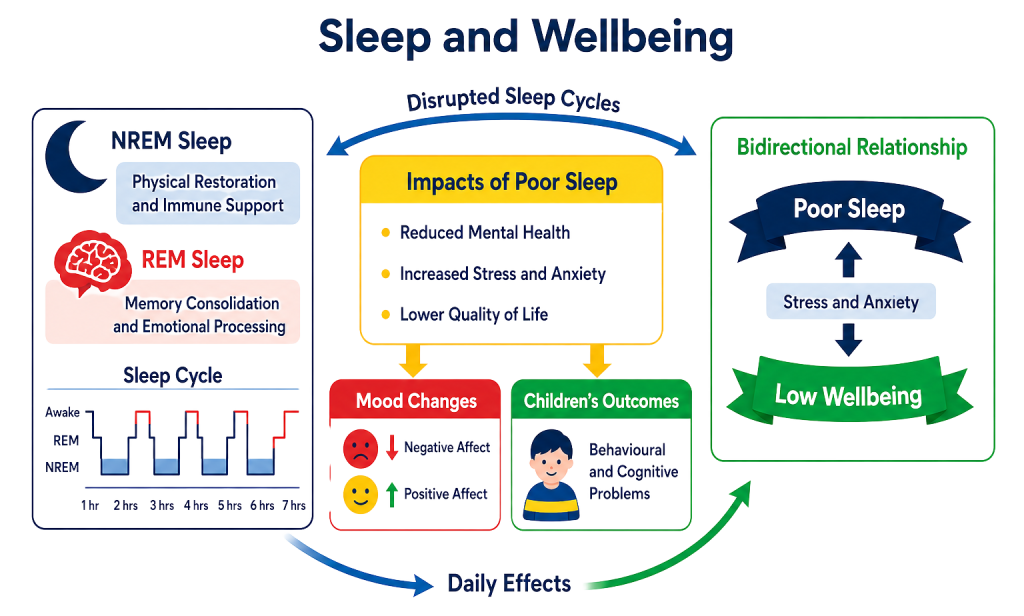
Sleep operates through complex biological cycles, alternating between non-rapid eye movement (NREM) and rapid eye movement (REM) stages. Deep NREM sleep supports physical restoration and immune functioning, while REM sleep is essential for memory consolidation and emotional processing (Lumen Learning, n.d.). When these cycles are disrupted, the consequences extend well beyond tiredness.
Research consistently shows that poor sleep quality is associated with reduced mental health, increased psychological distress and lower overall quality of life (Barros et al., 2019). Importantly, sleep and wellbeing share a bidirectional relationship. Poor sleep can reduce positive mood and life satisfaction, while stress and low wellbeing can, in turn, disrupt sleep (Scott & Woods, 2020).
Daily evidence reinforces this connection. Short-term fluctuations in sleep are associated with next-day changes in mood, including increased negative affect and reduced positive emotions (Konjarski et al., 2018; Lenneis et al., 2024). In children, insufficient or poor-quality sleep is linked to behavioural difficulties, reduced cognitive performance and poorer emotional regulation (Matricciani et al., 2019; Chaput et al., 2016).
Why Bedtime Routines Matter in Early Childhood
Within this broader context, bedtime routines emerge as a practical and evidence-informed strategy to support sleep and development. A bedtime routine refers to a predictable sequence of calming activities in the period before sleep. Research shows that consistent routines are associated with earlier bedtimes, faster sleep onset, fewer night awakenings and longer sleep duration (Mindell & Williamson, 2018).
Importantly, these benefits appear to be dose-dependent, with greater consistency linked to better sleep outcomes (Mindell & Williamson, 2018). Over time, consistent routines are thought to help regulate circadian rhythms, reduce pre-sleep arousal and create positive associations with sleep (Mindell & Williamson, 2018).
Beyond Sleep: Developmental Benefits of Bedtime Routines
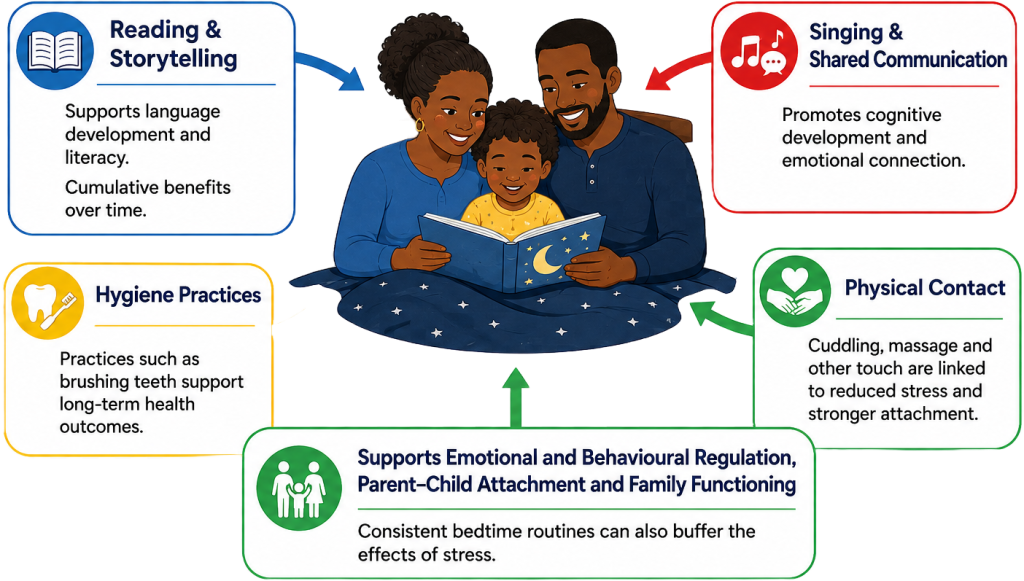
What makes bedtime routines particularly powerful is that their benefits extend beyond sleep itself. They provide a structured opportunity for nurturing care and developmental support during a time when caregivers are typically present.
Reading and storytelling support language development and literacy, with evidence suggesting cumulative benefits over time (Mol et al., 2008; Bus et al., 1995). Singing and shared communication promote cognitive development and emotional connection (Williams et al., 2015). Hygiene practices such as brushing teeth support long-term health outcomes (Sheiham, 2006), while physical contact like cuddling or massage is linked to reduced stress and stronger attachment (Field, 2010).
These activities align with broader developmental principles, and bedtime routines have been associated with emotional and behavioural regulation, parent-child attachment and family functioning. Bedtime routines can also buffer the effects of stress (Mindell & Williamson, 2018).
Practical Strategies for Children’s Bedtime Routines
For children, effective bedtime routines are simple, predictable and consistent.
Evidence suggests they should:
- Follow the same sequence of activities each night
- Include two to four calming activities such as bathing, reading or quiet conversation
- Last approximately 30 to 40 minutes
- Encourage positive caregiver-child interaction
- Avoid stimulating activities such as screen use
- Be adapted to suit the child’s age, needs and family context (Mindell & Williamson, 2018)
Sleep as an Upstream Driver of Child Wellbeing
Emerging research suggests that sleep influences wellbeing through indirect pathways. For example, better sleep quality is associated with lower levels of stress and better general health, which in turn are linked to higher life satisfaction in children (Blackwell et al., 2020). In this way, sleep can be understood as an upstream factor that supports children’s daily functioning and longer-term outcomes through these interconnected processes.
This also highlights the importance of subjective sleep experience. Research suggests that sleep satisfaction is a particularly consistent predictor of subjective wellbeing, compared to other sleep parameters which show more variable relationships (Lenneis et al., 2024). In other words, how individuals feel about their sleep appears to play an important role in overall wellbeing.
For the Grown Ups: Practical Strategies to Improve Sleep
Although bedtime routines are often discussed in the context of children, adults also benefit from consistent sleep practices. The following strategies are supported by research:
- Maintain a consistent sleep and wake time each day to regulate circadian rhythms
- Prioritise sleep quality by creating a calm, dark and quiet sleep environment
- Limit screen use before bed to reduce cognitive stimulation and light exposure
- Engage in regular physical activity, which has been shown to improve sleep quality and wellbeing
- Develop a wind-down routine such as reading or relaxation exercises
- Monitor stress levels, recognising the reciprocal relationship between sleep and wellbeing (Scott & Woods, 2020)
Final Thoughts
Sleep is a foundational component of wellbeing across the lifespan. In early childhood, bedtime routines offer a practical, low-cost and evidence-informed way to support not only sleep, but also broader developmental outcomes.
By focusing on consistency, quality and meaningful interaction, bedtime routines can become a powerful tool for promoting health, learning and emotional wellbeing, setting the foundation for positive outcomes well into the future.
………………………………………………………………………………
Written by Aimee Bloom. Aimee is the Product Manager at the Institute of Positive Education. She is responsible for crafting the Institute’s Positive Education Enhanced Curriculum (PEEC) from ELC – 12. An experienced teacher and writer since 2005, Aimee has taught in both primary and secondary contexts, and has written content for a variety of government and non-government agencies. She is passionate about supporting teachers and ensuring the wellbeing of children, both in our schools and around the globe.
……………………………………………………………………………
References
Barros, M. B. de A., Lima, M. G., Ceolim, M. F., Zancanella, E., & Cardoso, T. A. M. de O. (2019). Quality of sleep, health and well-being in a population-based study. Revista de Saúde Pública, 53, 82. https://doi.org/10.11606/s1518-8787.2019053001067
Bus, A. G., Van Ijzendoorn, M. H., & Pellegrini, A. D. (1995). Joint book reading makes for success in learning to read: A meta-analysis on intergenerational transmission of literacy. Review of Educational Research, 65(1), 1–21. https://doi.org/10.3102/00346543065001001
Chaput, J. P., Gray, C. E., Poitras, V. J., Carson, V., Gruber, R., Birken, C. S., MacLean, J. E., Aubert, S., Sampson, M., & Tremblay, M. S. (2016). Systematic review of the relationships between sleep duration and health indicators in school-aged children and youth. Applied Physiology, Nutrition, and Metabolism, 41(6), S266–S282. https://doi.org/10.1139/apnm-2015-0627
Field, T. (2010). Touch for socioemotional and physical well-being: A review. Developmental Review, 30(4), 367–383. https://doi.org/10.1016/j.dr.2011.01.001
Konjarski, M., Murray, G., Lee, V. V., & Jackson, M. L. (2018). The reciprocal relationships between daily sleep and mood: A systematic review of naturalistic prospective studies. Sleep Medicine Reviews, 42, 47–58. https://doi.org/10.1016/j.smrv.2018.05.005
Lenneis, A., Ahuti Das-Friebel, Nicole, Sanborn, A. N., Sakari Lemola, Henrik Singmann, Wolke, D., Adrian von Mühlenen, & Anu Realo. (2024). The influence of sleep on subjective well-being: An experience sampling study. Emotion. https://doi.org/10.1037/emo0001268
Lumen Learning. (n.d.). Stages of sleep. https://courses.lumenlearning.com/suny-hccc-ss-151-1/chapter/stages-of-sleep/
Matricciani, L., Paquet, C., Galland, B., Short, M., & Olds, T. (2019). Children’s sleep and health: A meta-review. Sleep Medicine Reviews, 46, 136–150. https://doi.org/10.1016/j.smrv.2019.04.011
Mindell, J. A., & Williamson, A. A. (2018). Benefits of a bedtime routine in young children: Sleep, development, and beyond. Sleep Medicine Reviews, 40, 93–108. https://doi.org/10.1016/j.smrv.2017.10.007
Mol, S. E., Bus, A. G., De Jong, M. T., & Smeets, D. J. (2008). Added value of dialogic parent-child book readings: A meta-analysis. Early Education and Development, 19(1), 7–26. https://doi.org/10.1080/10409280701838603
Scott, H., & Woods, H. C. (2020). Sleep and wellbeing: A bidirectional relationship and its implications for future research and intervention. International Journal of Environmental Research and Public Health, 17(8), 2883. https://doi.org/10.3390/ijerph17082883
Sheiham, A. (2006). Dental caries affects body weight, growth and quality of life in pre-school children. British Dental Journal, 201(10), 625–626. https://doi.org/10.1038/sj.bdj.4814259
Williams, K. E., Barrett, M. S., Welch, G. F., Abad, V., & Broughton, M. (2015). Associations between early shared music activities in the home and later child outcomes. Frontiers in Psychology, 6, 1808. https://doi.org/10.3389/fpsyg.2015.01808
