

How emotional self-regulation influences learning, resilience and long-term wellbeing
I remember the moment, although many years ago now. I had a beautiful Year 2 class filled with curious minds and boundless energy. I don’t remember what precipitated that moment. Maybe I was overstimulated by noise, maybe I was stressed about workloads, maybe I was exhausted. But I remember what happened next. I remember the moment I lost my cool and snapped at my class. Instantly, I realised what I’d done. I took a deep breath. I was disappointed with myself and filled with regret. I apologised to my class, seeking to repair our relationship. I explained that I’m in charge of my own emotions and I shouldn’t have reacted in that way. Their forgiveness was immediate, but the memory stayed with me much longer.
………………………………………………………………………………
Moments like this sit at the heart of emotional self-regulation. Not because we get it right every time, but because they remind us how powerful our emotional responses can be, both for ourselves and for the young people in our care.
Emotional regulation refers to the processes through which individuals influence which emotions they experience, when they experience them, and how those emotions are expressed (Gross, 1998). In classrooms, this isn’t an abstract concept. It’s lived, moment-to-moment, in interactions, reactions and relationships’.
For students, developing emotional self-regulation is foundational to both wellbeing and learning. Research consistently shows that how a student feels directly shapes how they engage with education. Students who can identify and regulate their emotions tend to achieve more academically, demonstrate stronger interpersonal skills and experience better mental health outcomes over time. Longitudinal evidence also suggests that early self-regulation predicts later academic success and broader life outcomes, including physical health and employment (Duckworth & Carlson, 2013; Robson et al., 2020).
There’s also a strong connection between self-regulation and resilience. As an internal protective factor, self-regulation enables students to navigate challenges, recover from setbacks and persist in the face of difficulty. In fact, higher levels of self-regulation have been shown to correspond with higher levels of resilience in young people (Artuch-Garde et al., 2017).
Importantly, emotional self-regulation is not about suppressing feelings. Evidence suggests that when students habitually suppress negative emotions, they experience fewer positive emotions and greater overall illbeing (Brackett et al., 2016). Instead, self-regulation involves awareness, understanding and intentional response. It is about noticing emotions, naming them and choosing how to act in ways that align with our values.
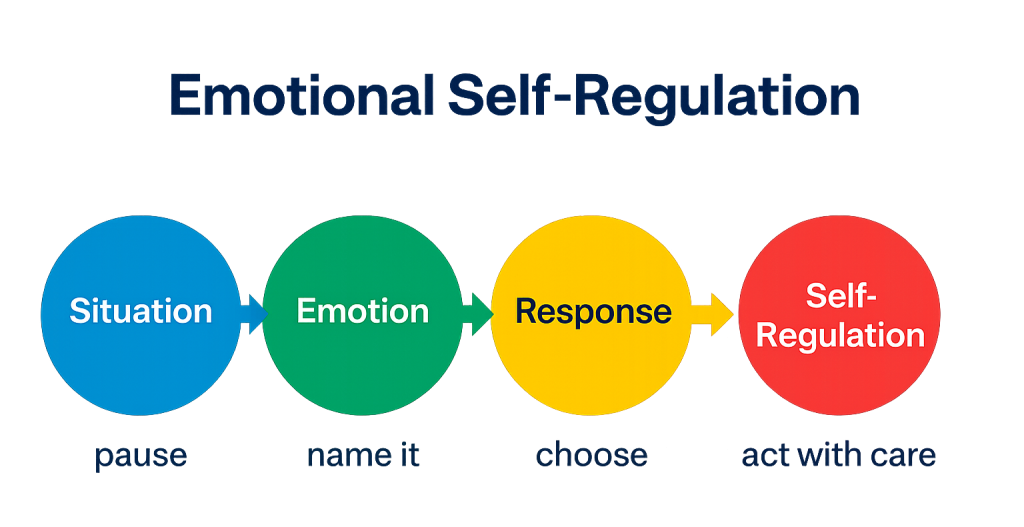
Neuroscience offers a helpful lens here. When an emotional reaction is triggered, a chemical process unfolds in the body that lasts around 90 seconds. If we can support students to notice this physiological response, rather than immediately reacting to it, we create space for regulation. The challenge lies in what happens next. Thoughts can quickly re-stimulate the emotional response, prolonging the experience. This is where skill development becomes critical.
There are numerous evidence-based strategies that support emotional regulation. These include selecting or avoiding situations based on anticipated emotional impact, modifying situations in the moment, directing attention intentionally, reframing interpretations and managing behavioural or physiological responses. Research suggests that strategies such as attentional deployment, cognitive change and response modulation can enhance positive emotions in the short term, while approaches like situation selection and ongoing attentional strategies contribute to longer-term emotional wellbeing (Quoidbach et al., 2015; Suri & Gross, 2016).
Acceptance also plays a key role. Approaches such as Acceptance and Commitment Therapy emphasise that we don’t need to control or eliminate emotions in order to function effectively. Instead, students can learn to accept emotional experiences while choosing actions that align with their values (Harris, 2009). When combined with mindfulness, this approach supports students to stay present and respond with intention. Without acceptance, however, mindfulness alone may inadvertently intensify negative emotional states (Wojnarowska et al., 2020).
For educators, this work begins with us. Classrooms are emotionally dynamic environments, and students are constantly observing how adults respond under pressure. When we model self-awareness, acknowledge mistakes and demonstrate repair, we provide powerful learning experiences that no worksheet can replicate.
At the same time, emotional self-regulation must be explicitly taught. Students benefit from structured opportunities to build emotional vocabulary, practise regulation strategies and reflect on their responses. Both proactive approaches, such as regular mindfulness practise, and responsive strategies, such as breathing techniques in moments of stress, have a place in this learning process.
………………………………………………………………………………
Returning to that moment in my classroom, what stayed with me wasn’t the mistake itself, but the opportunity it created. An opportunity to model accountability, to name emotions and to demonstrate that while we can’t always control what we feel, we can learn to respond with care.
In the end, emotional self-regulation isn’t about perfection. It’s about practise. And in schools, it is a practice that has the potential to shape not only how students learn, but how they live.
Written by Aimee Bloom. Aimee is the Product Manager at the Institute of Positive Education. She is responsible for crafting the Institute’s Positive Education Enhanced Curriculum (PEEC) from ELC – 12. An experienced teacher and writer since 2005, Aimee has taught in both primary and secondary contexts, and has written content for a variety of government and non-government agencies. She is passionate about supporting teachers and ensuring the wellbeing of children, both in our schools and around the globe.
……………………………………………………………………………………
Further Resources
Emotional Self-Regulation Pack (digital download)
This booklet includes a referenced research summary about emotional self-regulation, along with 29 different resources designed for a range of age groups to help support your students’ wellbeing.
The resource is designed to enhance students’ ability to recognise and label emotions and scaffold the co-regulation of emotions through hands-on strategies with view to developing students’ ability to engage in these practised strategies autonomously or with minimal support.
This is a helpful Positive Education resource for any teacher wanting to use mindfulness-based practices with their students. It provides simple yet effective ideas and activities that enable you to integrate mindfulness with ease.
The use of mindfulness-based interventions in schools is continuing to increase and there is an ever-growing body of research regarding their effectiveness. Research shows that practising mindfulness leads to improved levels of wellbeing for both teachers and students.
The activities are creative and grounding, offering an easy way to break up a lesson and allowing students and teachers to build connections while improving their sense of wellbeing.
Positive Education Enhanced Curriculum (PEEC)
PEEC is a research-based, developmentally sequenced Positive Education curriculum designed for students from Early Learning (age four) through to Year 12 (age 18). Drawing on over a decade of Positive Education experience at Geelong Grammar School (GGS) and created in consultation with world-renowned Positive Psychology researchers, PEEC provides a structured approach to wellbeing education.
PEEC is a comprehensive and adaptable Positive Education curriculum that supports schools in fostering student wellbeing through structured yet flexible lessons. By incorporating relevant research and practical experience, PEEC empowers educators to create environments where students can flourish both academically and personally. Explore our website to learn more about how PEEC can benefit your school community.
References
Artuch-Garde, R., González-Torres, M., de la Fuente, J., Vera, M. M., Fernández-Cabezas, M., & López-García, M. (2017). Relationship between resilience and self-regulation: A study of Spanish youth at risk of social exclusion. Frontiers in Psychology, 8, 612.
Brackett, M. A., Rivers, S. E., Bertoli, M. C., & Salovey, P. (2016). Emotional intelligence. In L. F. Barrett, M. Lewis, & J. M. Haviland-Jones (Eds.), Handbook of emotions (4th ed., pp. 453–466). Guilford Press.
Duckworth, A. L., & Carlson, S. M. (2013). Self-regulation and school success. In B. W. Sokol, F. M. E. Grouzet, & U. Müller (Eds.), Self-regulation and autonomy: Social and developmental dimensions of human conduct (pp. 208–230). Cambridge University Press.
Gross, J. J. (1998). The emerging field of emotion regulation: An integrative review. Review of General Psychology, 2(3), 271–299.
Harris, R. (2009). ACT made simple: An easy-to-read primer on acceptance and commitment therapy. New Harbinger.
Quoidbach, J., Gross, J. J., & Mikolajczak, M. (2015). Positive interventions: An emotion regulation perspective. Psychological Bulletin, 141(3), 655–693.
Robson, D. A., Allen, M. S., & Howard, S. J. (2020). Self-regulation in childhood as a predictor of future outcomes: A meta-analytic review. Psychological Bulletin, 146(4), 324–354.
Suri, G., & Gross, J. J. (2016). Emotion regulation: A valuation perspective. In L. F. Barrett, M. Lewis, & J. M. Haviland-Jones (Eds.), Handbook of emotions (4th ed., pp. 453–466). Guilford Press.
Wojnarowska, A., Kobylinska, D., & Lewczuk, K. (2020). Acceptance as an emotion regulation strategy in experimental psychological research: What we know and how we can improve that knowledge. Frontiers in Psychology, 11, 242.
