

Exploring the Link Between Volunteering and Student Wellbeing
As schools continue to prioritise student wellbeing, many leaders are searching for approaches that are both meaningful and evidence-informed. One strategy that’s gaining renewed attention, particularly during the International Volunteer Year, is student volunteering. The idea seems simple. When young people contribute to something beyond themselves, they may also strengthen their own wellbeing. But what does the research actually say?
What the Evidence Suggests
A growing body of research indicates that volunteering is associated with a range of positive outcomes for young people. Large-scale population data from the United States shows that children and adolescents who engage in volunteering are more likely to be in excellent or very good health and to be flourishing, with lower odds of behavioural problems and lower levels of anxiety (Lanza et al., 2023).
Similarly, research has found consistent associations between volunteering and improved mental health, wellbeing and social outcomes in young people, including higher life satisfaction, increased empathy and social awareness, and reduced engagement in risky behaviours (Hernantes et al., 2019; Alzaareer, 2024). These findings suggest that volunteering may support several key domains of wellbeing, particularly those related to purpose, belonging and positive relationships.
From a developmental perspective, this makes sense. Adolescence is a period characterised by identity formation and an increasing need for social connection. Volunteering can provide structured opportunities for young people to build competence, contribute to their communities and develop a sense of meaning beyond themselves. It may also support wellbeing through specific psychological mechanisms such as increased purpose, stronger social connectedness and reduced self-focus, which are particularly relevant during adolescence (Ballard et al., 2021).
A More Nuanced Picture
While these findings are promising, it’s important to approach them with care. Much of the research in this area is correlational. This means we can’t confidently conclude that volunteering causes improvements in wellbeing. It may be that young people who are already more engaged, supported or psychologically well are simply more likely to volunteer in the first place.
Experimental evidence helps to clarify this issue, and the results are more mixed. In a randomised controlled trial, students who participated in an intensive community service learning programme did not show improvements in subjective wellbeing compared to a control group (Whillans et al., 2016). This challenges the assumption that volunteering automatically leads to better wellbeing outcomes.
Importantly, this does not mean volunteering has no value. Rather, it highlights that the relationship between volunteering and wellbeing is complex and influenced by factors such as motivation, context and programme design. For example, when volunteering is highly structured, time-intensive or externally imposed, it may not produce the same benefits as experiences that are more autonomous and meaningful.
What This Means For Schools
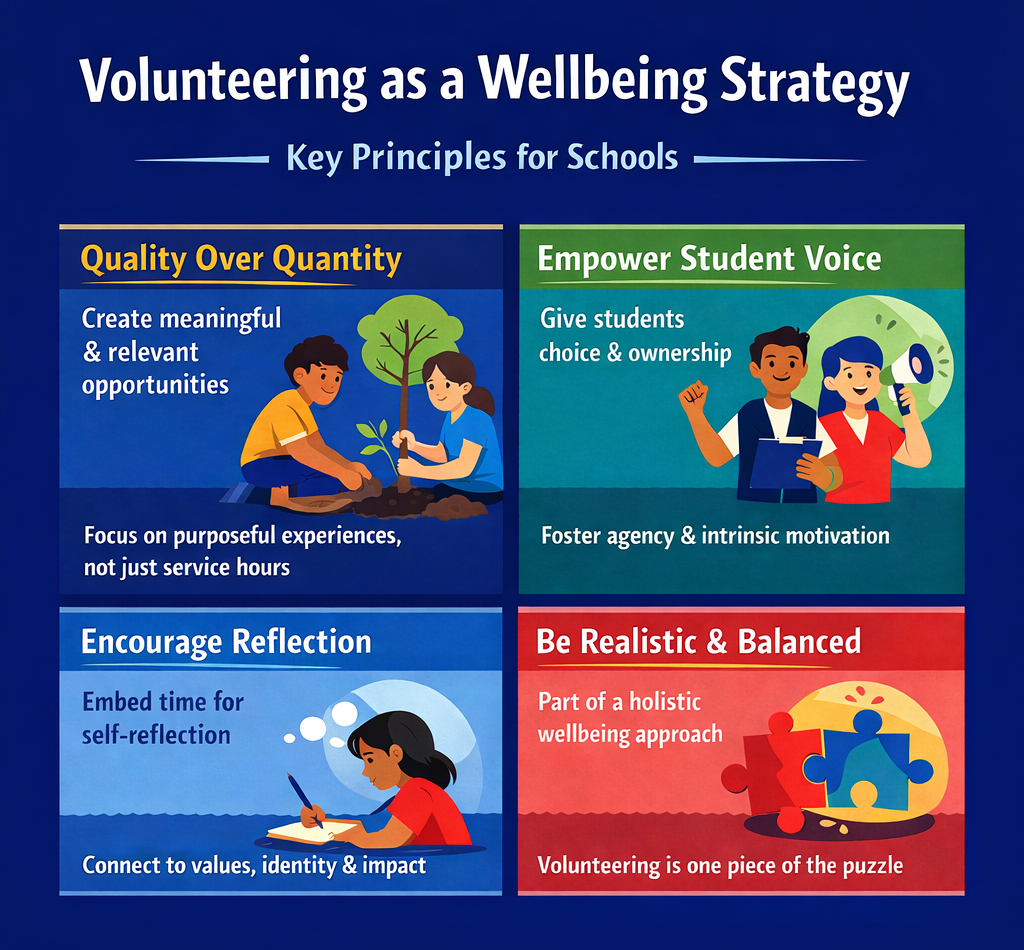
For teachers, Heads of Wellbeing and school leaders, volunteering presents a promising opportunity to support wellbeing. But like any strategy, it needs to be implemented thoughtfully.
Quality matters more than quantity.
Simply requiring students to complete service hours is unlikely to deliver meaningful benefits. Instead, schools should focus on creating opportunities that feel purposeful, relevant and aligned with students’ interests.
Student voice is critical.
When young people have choice and ownership over how they contribute, volunteering is more likely to support intrinsic motivation and a sense of agency, both of which are linked to wellbeing.
Reflection should be embedded.
Structured opportunities for students to reflect on their experiences can help them connect their actions to broader themes such as values, identity and impact, strengthening the potential wellbeing benefits.
Expectations should be realistic.
Volunteering is not a standalone solution to complex wellbeing challenges. Rather, it’s best understood as one component within a broader, whole-school approach to student wellbeing.
Looking Ahead
As the International Volunteer Year continues, schools are well placed to reconsider how volunteering fits within their wellbeing strategy. The research suggests there’s genuine potential, particularly in relation to flourishing, connection and behaviour. At the same time, it reminds us that impact is not guaranteed.
The opportunity for schools is not simply to do more volunteering, but to do it better. When thoughtfully designed, developmentally appropriate and meaningfully integrated, volunteering can indeed become a valuable piece of the student wellbeing puzzle.
Written by Aimee Bloom. Aimee is the Product Manager at the Institute of Positive Education. She is responsible for crafting the Institute’s Positive Education Enhanced Curriculum (PEEC) from ELC – 12. An experienced teacher and writer since 2005, Aimee has taught in both primary and secondary contexts, and has written content for a variety of government and non-government agencies. She is passionate about supporting teachers and ensuring the wellbeing of children, both in our schools and around the globe.
……………………………………………………………………………………
Further Resources
PEEC Subscribers have access to lessons designed to be taught during International Year Volunteer (IYV) 2026. https://teachpeec.com/resources/general-resources/national-volunteer-week-lessons/
References
Alzaareer, A. (2024). The Effects of Volunteering on Students’ Wellbeing: Evidence-Based Outcomes. 253–279. https://doi.org/10.1007/978-3-031-76730-2_13
Ballard, P. J., Daniel, S. S., Anderson, G., Nicolotti, L., Caballero Quinones, E., Lee, M., & Koehler, A. N. (2021). Incorporating Volunteering Into Treatment for Depression Among Adolescents: Developmental and Clinical Considerations. Frontiers in Psychology, 12. https://doi.org/10.3389/fpsyg.2021.642910
Hernantes, N., Pumar-Méndez, M. J., López-Dicastillo, O., Iriarte, A., & Mujika, A. (2019). Volunteerism as adolescent health promotion asset: a scoping review. Health Promotion International, 35(3). https://doi.org/10.1093/heapro/daz026
Lanza, K., Hunt, E. T., Mantey, D. S., Omega-Njemnobi, O., Cristol, B., & Kelder, S. H. (2023). Volunteering, health, and well-being of children and adolescents in the United States. JAMA Network Open, 6(5), e2315980. https://doi.org/10.1001/jamanetworkopen.2023.15980
Whillans, A. V., Seider, S. C., Chen, L., Dwyer, R. J., Novick, S., Gramigna, K. J., Mitchell, B. A., Savalei, V., Dickerson, S. S., & Dunn, E. W. (2016). Does volunteering improve well-being? Comprehensive Results in Social Psychology, 1(1-3), 35–50. https://doi.org/10.1080/23743603.2016.1273647
